An individual’s encounter with an art piece can evoke admiration, resonance, and curiosity. Through various art forms such as painting, music, dance, and sculpture, one finds oneself moved to seek a deeper understanding of oneself and one’s perception of the art itself. Unlike the performing arts, sculpture is still, and yet within its stillness, the essence of a being is captured. Unlike an image or a painting, sculptures provide a multidimensional whole and an independent object, allowing viewers to engage with it at multiple angles and through their sense of touch. Often depicting bravery, strength, or beauty, these sculptures successfully hold our attention, but art that we find awe-inspiring may also depict an untrue ideal. Diadoumenos exists between the truth of humans’ lived experience and an idealized version of excellence, prompting viewers to look inward and through its attempt to obscure imperfection.
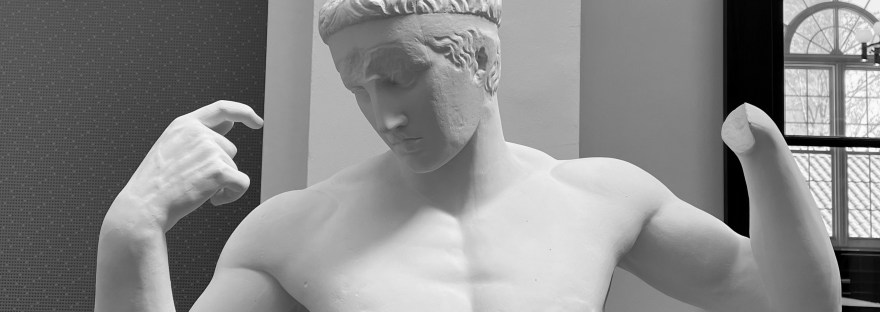
The head of the sculpture Diadoumenos can be seen at Emory University’s Carlos Museum (fig.1), along with a provided display of details (fig.2), but a copy of the entire body of the statue can be seen at Emory University’s Candler Library (fig.3). The entirety of the sculpture depicts a young man with an athletic build, tying a ribbon around his head to symbolize victory, hence the name Diadoumenos meaning ‘ribbon-binder.’ We see the posture to be contrapposto, an attribute of many other sculptures by Polykleitos, creating a slight asymmetry for a more natural look and using a mathematical system to create perfect bodily proportions, also known as the canon of Polykleitos.
What makes this sculpture stand apart, upon closely considering the facial expressions, the lowering of the head towards the ground (fig.4) is the depiction of personal reflection, perhaps internal harmony or a feeling of emptiness despite victory. This stark contrast between success in external forms such as beauty, physical strength, and victory with internal turmoil creates layers to Diadoumenos’ interpretations.
To gain a deeper understanding of what Diadoumenos, and sculpture itself might mean to the viewer, it’s essential to explore what sets sculpture apart from other mediums, and what senses it may interact with that other forms of art may not. On this note, we can introduce Johann Gottfried Herder’s work comparing painting with sculpture, particularly highlighting the idea that sculpture is truth and painting is a dream. Herder backs this argument by explaining the gaps between experiencing an object through touch, or solely sight alone, “sight reveals merely shapes, but touch alone reveals bodies.” (Herder 35). He further adds to this idea, “In all of these cases sight is but an abbreviated form of touch. The rounded form becomes a mere figure, the statue a flat engraving. Sight gives us dreams, touch gives us truth.” (Herder 38)
Applying these ideas to Diadoumenos, we see how truth in a sculpture may be depicted by the fact that a single sculpture can be viewed from various angles, the same way any human could be perceived from various angles, not limited a two-dimensional image. The stillness of this sculpture and the size being similar to another human body create room for resonance. Like the viewer, despite having one form, the sculpture does not hold any specific shadows or dimensions. Unlike a painting or image, the sculpture stands alone, independent and whole, without any objects associated with it, except itself.
In line with Herder’s arguments, we can argue that the experience of Diadoumenos were it merely a successful athlete, on a canvas, or the image of one on film, would be that of sight alone. Though this image may still stir our imagination, Diadoumenos would no longer be present in bodily form, taking up space in the same room the viewer is in.
This specific attribute of sculptures is what makes them seem as an entire entity on their own, and perhaps even a companion to the viewer, “A sculpture before which I kneel can embrace me, it can become my friend and companion: it is present, it is there (page 45, Herder).” The idea of being embraced by a sculpture as Herder mentions here, directly points to why a sense of touch, differentiates an embodied soul from a mere surface. Sight alone, may evoke imagination and allows for several objects to be on opposition or in harmony with one another, but touch gives realism, proof of existence, truth and companionship to the viewer.
In Diadoumenos, this effect is strong since not only is the human body one we can recognize, be inspired by, and find companionship in, but the contrast of emptiness during a time of victory suggests this sculpture might have an inner world as rich and as complicated as our own.
However, Herder’s idea of sculpture as the truth may not be entirely representative or even true of the human experience or the human body. The perfect proportions, smooth and strong body of Diadoumenos, made of marble and perfected into stillness may represent only the epitome of the human experience, of few individuals often disregarding a variety of body types and the subjectivity of beauty and excellence itself. This attempt to solidify and sculpt into marble flesh and skin that evolves, beauty that ages and triumph without struggle may create a false ideal or a heightened, more sophisticated and utopian version of reality. Though this attempt to freeze into time and stillness a human body and mind that is ever evolving and diverse does elicit admiration, but it also creates a sense of envy and idealization.
On that note, we can also question Herder’s ideas on only worthy objects being sculpted into stone, “Nothing is gained from sculpting toads and frogs or rocks and mattresses if they do not serve some higher work as accessories without raising any claim to be the principal subject. What sculpture should create, and what it has succeeded in creating, are forms in which the living soul animates the entire body, forms in which art can compete in the task of representing the embodied soul.” (Herder 45) Here, it’s important to consider whether Diadoumenos is the only representative form of an embodied soul, and question why, if there is a living soul depicted in Diadoumenos, is it only captured in a moment of utmost excellence?
Ideas around the worthiness of a being or object being sculpted allow us to acknowledge the exclusivity that sculptures may provide. Subjects such as Gods, or Emperors in grandiose gestures in glorious moments, have us raise questions on why victory alone is celebrated. We may see these sculptures with a lens of idealization, since what is absent from such art pieces is the very essence of human struggle, the pain, sweat, and imperfection precedes and paves the way to excellence. We can ask ourselves, if struggle is as essential to the human experience as is accomplishment, why do we only glorify one over the other, and why does our art prefer to showcase perfect outcomes rather than our imperfections?
This idea of imperfections and excellence combined in one being, is worded by Aristotle in his work on the body and the soul and how they may be interconnected, “So, too, the attributes of the soul appear to be all conjoined with body: such attributes, viz., as anger, mildness, fear, pity, courage; also joy, love and hate.” (Aristotle 7) With these lines, we learn that the imperfections such as emotions, which may be interpreted as an obstacle to our goals, are merely extensions and attributes to our soul, communicated through our body. Even though Diadoumenos, does not explicitly show intense emotions, we can attribute a soul by our interaction with the sculpture frozen post-victory, by our own experiences with success, and in this way the sculpture becomes a subjective encounter, deeply personal and specific to each viewer. We may assume a sense of pride, relief, exhaustion or lack of meaning in success from the sculpture’s face, and similarly we may notice multiple emotions in conflict with one another. Upon winning, the sculpture may be both proud and brooding.
Aristotle’s ideas on the soul, show us more clearly what is absent in the perfect representation of the human body and victory as depicted in Diadoumenos. The lowered gaze, without any explicit or extreme emotions shows restraint, and perhaps suppression of these emotions. This could lead us to think that in the same way Herder claimed an object must be worthy enough to be sculpted, perhaps an ability to endure or suppress extreme emotion made one worthy. However, in Aristotle’s work we see how emotions are but attributes, and pain, joy, suffering or a lack thereof would not change a subject’s worthiness or determine the quality of its soul. Had Diadoumenos been defeated, would his form be sculpted into marble? Instead of a calm, brooding expression if were of anger or despair, would it still elicit awe and inspire the viewer?
To answer these questions, we must know how humans interact differently with pain and pleasure. In Edmund Burke’s words, “Without all doubt the torments which we may be made to suffer are much greater in their effect on the body and mind than any pleasures which the most learned voluptuary could suggest, or than the liveliest imagination, and the most sound and exquisitely sensible body could enjoy.” (Burke 34) Here, Burke explains how pain and torment can have a lasting and greater effect as felt in our body, than that compared to the experience of utmost pleasure and joy. This illustrates how pain depicted within art is more likely to evoke a stronger emotion within individuals and create a stronger level of connection to the art itself. Diadoumenos does not necessarily attempt to evoke feelings of empathy or convey despair, but quite the opposite, the perfect sculpture seems instead to impress and appeal. However, because of the effect that suffering can have on individuals, we might be tempted to seek that in how we interpret art, in this case, specifically in Diadoumenos’ lowered gaze.
Burke’s explanation of man’s desire to break down the partitions of their own minds, to fully explore a new concept, or the unfamiliar links closely to the seemingly unfulfilled gaze of Diadoumenos. Unlike other sculptures of its time, Diadoumenos does not gloat in victory, or depict facial expressions of entitlement. Upon considering what the statue may be reflecting on, we are urged to assume it may too be attempting to break through the partition within its own mind and soul, since the sculptures suffering is what gives the individual viewer a story and meaning behind the marble sculpture. Diadoumenos intrigues us for the possibility of it depicting a soul contemplating its own adequacy and value amidst worldly success.
In this way, Burke challenges Herder’s ideas of only worthy objects being sculpted. When the idea that only specific aesthetics and values such as power, strength and victory should be displayed in sculptures, solely by the powerful, strong and victorious, we begin to ask ourselves if these perfectly proportioned and detailed sculptures represent the entirety of what makes a soul, regardless of the body they live in.
Gikandi’s work in Slavery and Culture of Taste highlights the role of political economies in determining what and who fits the aesthetic. His work allows us to realize how acquired taste may only be developed by the privileged and might lead to misrepresentation or underrepresentation of marginalized communities. Gikandi asks questions like, “What was the relation between aesthetic objects and the political economy of slavery? How could such elevated images of art exist in the same realm as the harsh world of enslavement and the slave trade?” (Gikandi 3) Even though his ideas specifically tie to slavery, we can use them to put Diadoumenos’ sculpture into context by asking what communities and individuals were underrepresented or did not qualify as the embodiment of a perfect body or victory that are missing from the picture. The sculpture helps us realize that victory or perfection itself is only a utopian version of what excellence may look like, purely based on accomplishment and beauty, disregarding the soul.
To add to this point, one final way to understand Diadoumenos is through the role time plays in both art, and the human experience. Since Diadoumenos is a sculpture frozen in time, without a depiction or even proof of past struggles, or a future goal or aspiration to look forward to, we come to question how truthful and real this depiction of human life really is. Despite victory, the sculpture is still in a moment, never growing or changing henceforth, this is what differentiates it from the possibilities of being alive, and opportunities for growth. Although we have questioned why only triumph, power and moral goodness is represented in this sculpture, perhaps capturing these qualities represents our desires as humans to stay frozen in a form that we are proud of, and in moments that we’re successful, and to then create sculptures that represent our most glorious moments. Perhaps sculptures serve to inspire and remind us of our potential, rather than showcase the full scope of the sacrifices we make to succeed.
Regardless, Herder’s idea that sculpture is truth may only be partially true. Diadoumenos does not depict defeat, pain, or imperfection, but it’s silence and stillness creates room for viewers to decide for themselves what the ribbon bearers’ story truly is. The lowered gaze of the sculpture, reflecting inwards, prompts viewers to acknowledge the full scope and depth of their lived experience, especially the pain and suffering it takes to become victorious for a moment in time, instead wishing for the absence of it.
In this way, the face of Diadoumenos exists in conflict with the rest of the body, by showing movement through thoughts, a soul unfulfilled, and undergoing constant transformation. The co-existence of truth and idealization is what makes encountering Diadoumenos as a sculpture initially awe-inspiring but eventually, a journey into questioning how satisfied one’s soul is despite external achievements, and the value of oneself despite youth, vitality and physical strength. Diadoumenos, a complete and independent sculpture, frozen in time, holds within its eye sockets an on-going, unfinished journey, of an imperfect soul. The statue seems to be self-aware in knowing it depicts a truth it itself doesn’t believe to be true or important. In conclusion, viewers are left to question for themselves whether Diadoumenos embodies the true human experience or dictates an idealized version of what it should be.
Figures
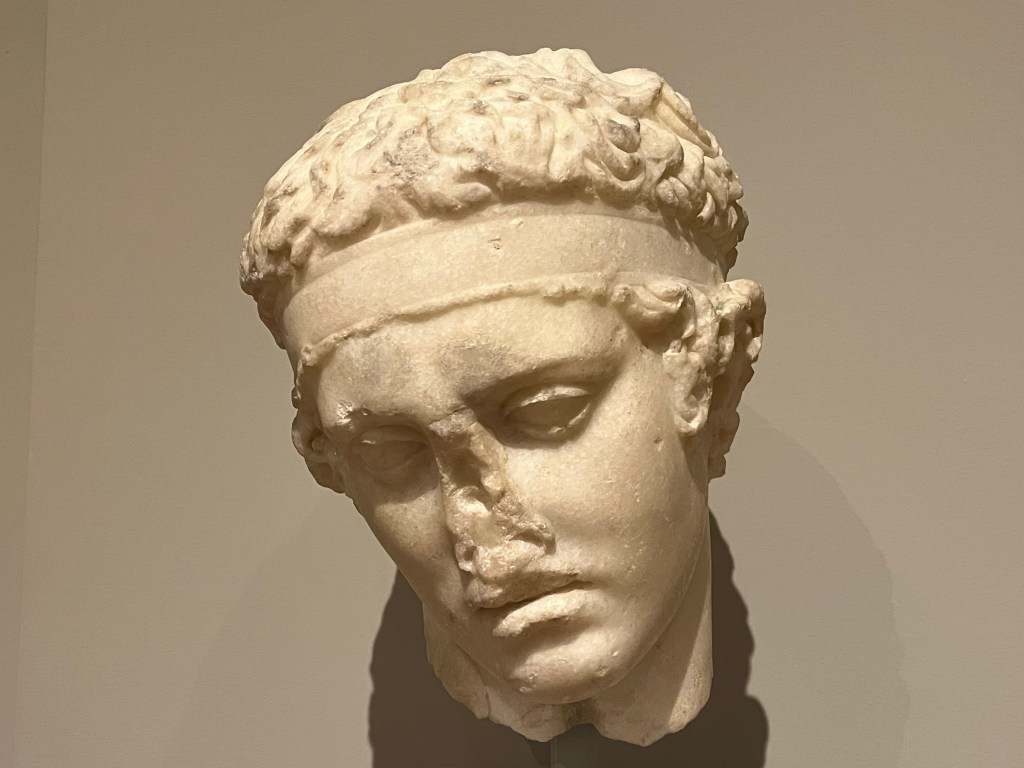
Fig.1 Head of Diadoumenos, Carlos Museum
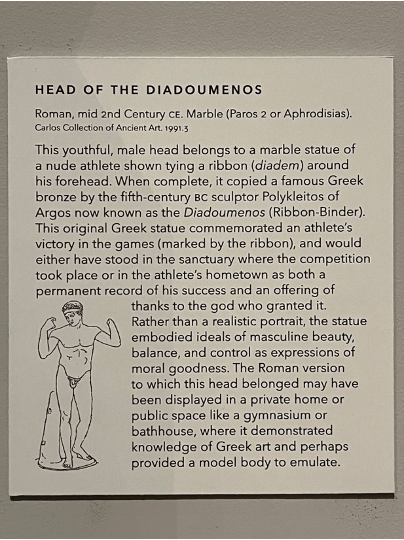
Fig. 2. Detail view, Carlos Museum
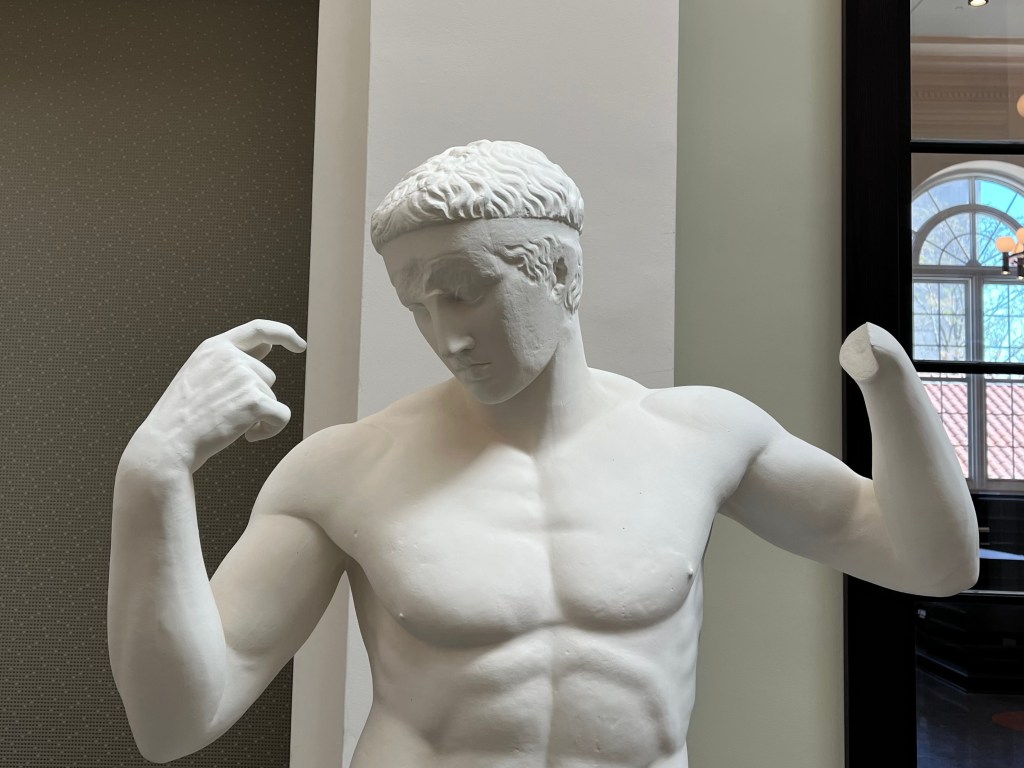
Fig. 3 Full-body replica, Candler Library
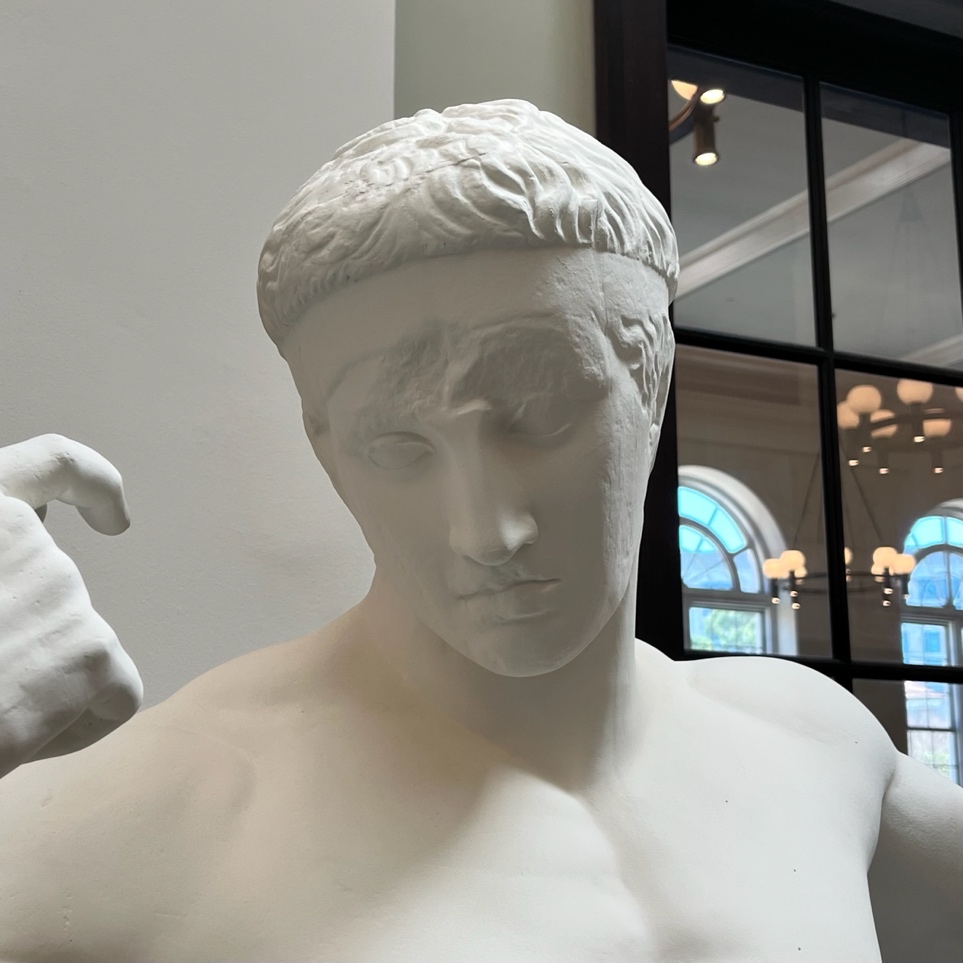
Fig. 4. Detail of lowered gaze
Works Cited
Herder, Johann Gottfried. Sculpture: Some Observations on Shape and Form from Pygmalion’s Creative Dream. Translated by Jason Gaiger, University of Chicago Press, 2002,
Aristotle. Aristotle’s On the Soul: And, On Memory and Recollection. Green Lion Press, 2004,
Burke, Edmund. A Philosophical Inquiry into the Origin of Our Ideas. Start Publishing LLC, 2012,
Gikandi, Simon. Slavery and the Culture of Taste. Princeton University Press, 2011,
 metacogmoon.com